Talk · 8 December 2026
Knowledge Was Never Meant to Look Like This
Experts ‘think’ in journal articles.
What if they could ‘think’ in movies, games, performance art, playable essays?
I invent things
→that didn't have a category yet.
World-breaking → world-making

A design-led alternative academic press and knowledge design laboratory, publishing ideas in every form the journal article forecloses.
Classrooms, seminars and studios now produce games, films, inventions, fiction and art. The landscape of knowledge production has changed massively; academia’s archive hasn’t. Outside the library, there is nowhere for knowledge that isn’t text to live. We’re building one.
UFP’s production slate, including an animated series pitting indigenous robots against Silicon Valley robots in future deep time; a game where you need human rights law to win the final level; guerrilla detonations across the City of London; and fifty-two goos, each one a metaphor with a body.
A creative technology capturing the life and soul of an idea mid-motion, and the moss it gathers as it rolls across public discourse.
UFP’s public programme. A parallel press needs a parallel laboratory: traditional academia trains people to write papers for traditional academic publishing; the Lab trains people to make knowledge artefacts for UFP, through hands-on labs, salons, exhibitions, and experiments in what knowledge can become.
As it stands, UFP is also an economic intervention. It functions as a flywheel of capital and wages connecting scholars, designers and artists. An economic container for talents that existing institutions struggle to accommodate.

A body of work in the public interest. It’s built on one idea: law isn’t just a technical instrument. It designs worlds, and it is itself design material: its categories can be taken apart and recomposed. The governed can design it back.
An intellectual agenda and subdiscipline I founded. Shiny new things, from de-extinction and decentralised digital planets to indigenous robots and plant-object cyborgs, unsettle the ancient metaphysical constructs that hold social reality together. The agenda helps scholars, lawmakers and the rest of us work out what these things are, and what we owe them, before the old categories decide for us.
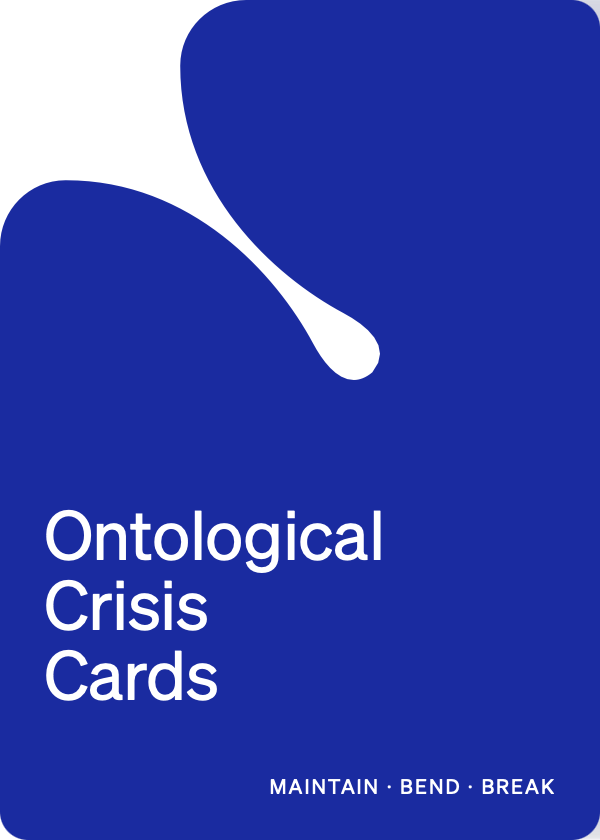
A card game that tests whether existing law can accommodate AI and other frontier technologies. Each card presents a legal edge case that hasn’t happened yet, but is likely to.
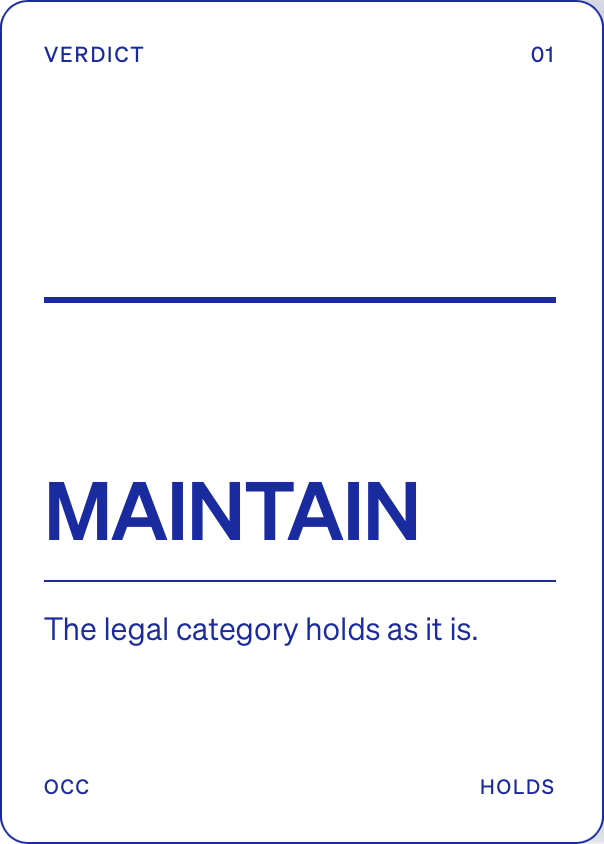
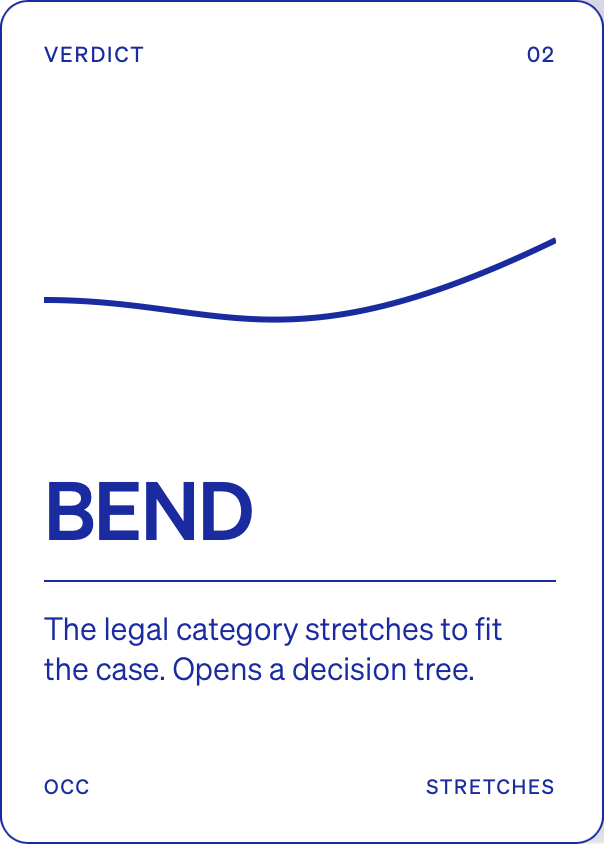
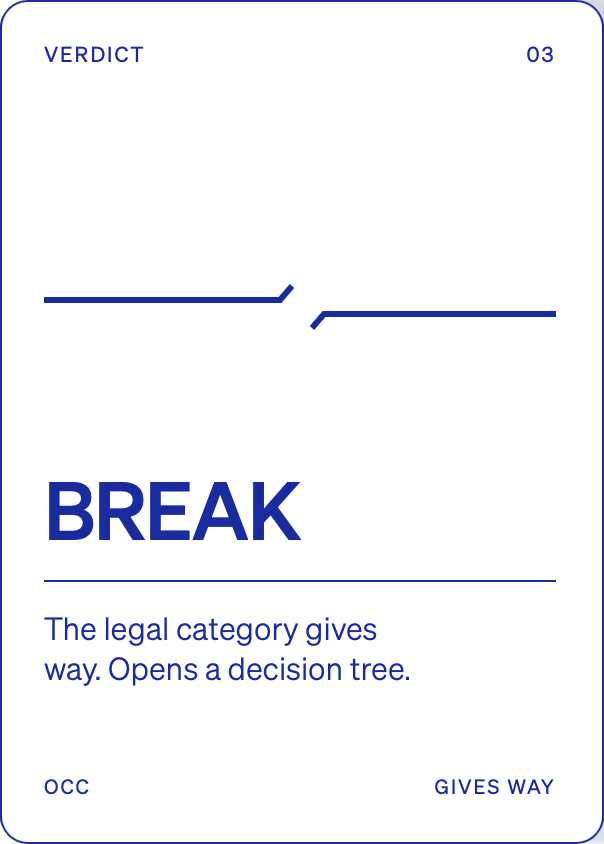
Players decide whether to MAINTAIN, BEND or BREAK the relevant legal categories. Every BEND or BREAK opens a decision tree. Then what follows is epistemological Jenga: players take apart the categories they’ve been given and reassemble them into a UN-style resolution.
Two versions
· AI-specific: 50 edge cases
· Frontier technology: 100 edge cases
Designed for
· Policymakers
· Legal professionals
· Activist movements
· Business schools
Pure Sovereignty · in press
Juridical Scavenging · in press
Hermeneutic Statecraft · in press
A book of visual essays on how law is designed, and how it could be redesigned. Its methods are portable and transferable, built to be picked up and used outside the book. Especially salient in the following use cases:
· Biodesign
· Ecology
· Avant-garde inventions
Legal frameworks and negotiator training for equitable, decolonial space environmentalism. Space as a civic inheritance, not a private estate.

National literary prize-winnerA metafictive literary genre in which schools of thought become characters. Philosophical arguments acquire motives, enter conflict, and unfold through plot.
Postgraduate Admissions: a metafictive satire in three layers. It satirises the world, satirises the notion of a satire. Satirises itself.
At a fictionalised version of LSE just after Brexit, four professors convene to decide the fate of the world. They are schools of thought in human form, each arguing for the future they want. The decision takes the form of a single postgraduate admissions place that rearranges the balance of the world.
First published 2016. Staged in London, 2018. Tenth-anniversary edition forthcoming.
A CGI-animated anthology of short films. Political Fictions: what if jurisprudence had a body? Legal concepts bleed, glitch and wage war. In development.

An instrument for interpretation; an intervention in the philosophy of knowledge. Things are evolving; thought has to catch up. This is a device that bridges the future of things and the future of thought.
Three crises reinforce each other. MIMICRY is the copy-paste economy of “turns”: one celebrated scholar announces a meta-trend, and the field copies its argument scaffolding into every empirical setting, whether it fits or not. Only the evidence changes, and it’s easy to fake. PROJECTION is the interpreter’s own conditioning deciding what a reading finds. Positionality statements and reflexivity name it; they rarely undo it. This hermeneutic goes further, asking interpreters to work through their own projections, as one would in therapy, before they read. ABDICATION keeps theory apart from civic action, insulating both the framework and its interpreter from practical demands that could challenge them and require fresh thinking.
The doctoral research in which the hermeneutic was developed and applied: 77 interviews and more than 10,000 messages of digital ethnography. Funded by Gates Cambridge.
↳ inside Uncommon Future Press · Inventor's notes
I invented Alt-CINDEX, a creative tech that tracks the impact of an idea as it rolls across public discourse.
The idea behind it is simple. In our bibliometric systems, our society has tended to favour quantitative scoring to measure impact: number of citations, likes, views, downloads, which are additive and valence-blind. But a citation that refutes a paper adds the same +1 as one that builds on it; the model offers no further complexity of information. To glean more, our tools do segment these primitives, but only into further numbered chunks that reinforce the valence-blindness: proportion of men versus women, number of UK versus US readers, time of day of clicks and views. But these are low-fidelity data categories.
Alt-CINDEX inverts these by tracking the qualitative life and soul of an idea. It treats an idea, or a piece of knowledge, as a rolling stone that gathers moss, deliberately inverting the proverb. As it rolls, it takes on force, disputation, inspiration, momentum, distance of travel; it even propagates its theoretical lineage, which acts as a Hebbian pathway: the more often the discourse fires along it, the more it hardens into the public imagination as ‘normalised’ truth. Alt-CINDEX therefore is a taxonomic record of epistemic ruckus.
Take a climate modeller in Cambridge, UK, whose disaster risk model starts gathering news cycles and media attention in Kenya. When their model is adopted by the Kenyan Ministry of Environment, that is proverbial ‘moss’ that gets captured by the model.
Inspiration
I invented Alt-CINDEX when I was building the ‘world’ of Uncommon Future Press. UFP is a design-led, alternative academic press; a parallel reality where the ‘journal article’ is not the primary currency of knowledge exchange, where people can select the literary or artistic form best suited to their intellectual experiment, and where there is a ‘nano-economy’ that becomes a fly-wheel for capital and resources. Its project is to open up what has been foreclosed by traditional academic publishing, which chose an artificial genre — the journal — as the only mode of legitimate intellectual exchange.
So I thought: if we ‘world’ an alternative press house, we need an alternative bibliometric system too. And what needs changing about the citation system? First, its inherited formats — APA, Harvard, MLA — took form in a world of printed matter, before digital publishing. Names did more than attribute authorship then: they helped readers navigate alphabetical catalogues toward physical books. Titles, editions, volumes and page numbers acted as latitude and longitude; coordinates pointing to geography. Now, decades later, the citation system still carries the residues of that world.
Second, traditional citation is a string of low-density information. So what would high-density information look like? What would I like to see about an idea beyond its address? I find that discourse is at its best when captured mid-motion, rather than held static and opaque. I wanted the new citation system to hold that motion and take an ever-updating snapshot of it: what happens to an idea as people encounter it, contest it, transform it and put it to work.
Alt-CINDEX has an even more interesting role in the context of UFP. In its nascence, I was asked: What about peer review? That design problem became ‘captured’ by Alt-CINDEX, which would become our peer review mechanism.
In conventional peer review, readers inherit a verdict from two people that are vetted by powerful institutions who are, themselves, fallible. Readers don’t get visibility or access to the thinking that produced the verdict. Alt-CINDEX solves that by introducing a post-facto peer review: get the idea out first, then debate whether it’s good or bad on the index dashboard. The dashboard then logs support, contestation, transformation, and downstream uptake. These remain visible as the work gathers a public life beyond its initial approval.
From there, the computational world of Alt-CINDEX became more coherent. Inside its dashboard, each knowledge object gets its own ‘impact universe.’ The reader can follow it inward, through its discipline, and outward, toward the public. Even trace its hermeneutic lineage. Encounter the emotional valence of its reception. The design-led dashboard is how you enter that world.
Talk · Hosted by Pints of KnowledgeTalkTalk by Catherine D.L. Tan · Hosted by Pints of Knowledge
Experts ‘think’ in journal articles.
What if they could ‘think’ in movies, games, performance art, playable essays?
Catherine D.L. Tan·Camden Town Brewery, London·Tuesday 8 December 2026, 7pm·Hosted by Pints of Knowledge
For centuries, serious knowledge has been trained into a strangely narrow shape: the journal article. Linear, textual, compressed, and built for citation by other texts of its kind. It hates oratory and conversation; it imagines an audience that is “talked at” rather than “talked with.” And traditional academia loves this literary form, to the point of publish-or-perish.
But plot twist: there is nothing inevitable about this form.
It wasn’t designed by, or for, intellectuals. Not then, and especially not now. We now have game departments and MAs in Podcasting. We bend genres through film. Lawyers are building legal tech apps. Knowledge has turned out to be too spatial, sensory, emotional, nonlinear, interactive, and simply too large to survive compression. We lose something when we flatten this richness into linear, mechanical text that lives behind a paywall.
In this talk, Catherine D.L. Tan traces the evolution of knowledge media and asks what academic publishing leaves behind when it treats the paper as the natural endpoint of thought. Moving from the Gutenberg press to contemporary citation systems, she explores how media do more than communicate ideas: they shape which kinds of ideas can exist, travel, accumulate authority, and survive. Ultimately, she argues that every literary genre, from poetry to the journal article, carries its own political economy. It is a story with winners and civic stakes: whoever owns the vessel knowledge rides on decides who gets to know.
The talk then leaves the past and opens the doors of Uncommon Future Press (UFP), a publishing house doing for academia what A24 did for film. UFP publishes across every genre knowledge can inhabit: CGI animated films, design-led books, epistemic exhibitions, guerrilla publishing, performance art, and more. And it has devised the system that makes this rigorous rather than eclectic, including Alt-CINDEX, a creative technology that reinvents citation itself. It turns a low-density string of text into a high-density artefact that tracks the life of an idea: its impact, how well it is absorbed, its emotional force, how much moss it gathers as it rolls through the world.
This is not “death to the journal article!” just yet. But it is an argument against its inevitability.
If knowledge can evolve, what would it look like next?
Speaker
Catherine D.L. Tan is the Founder and CEO of Uncommon Future Press, a design-led press and knowledge design laboratory reimagining what academic publishing could become after the journal article. She’s a legal philosopher × design futurist, working on a book about law as design material.
She’s also a Gates Cambridge Scholar and former economic diplomat who wrote oratorical texts, won a prize for epistemological satire, and cares deeply about the life and plight of literary forms. She invented Alt-CINDEX, a creative technology that tracks how much qualitative ‘moss’ an idea gathers as it rolls across public discourse.
Talk · Hosted by LSE Alumni & LSE CareersTalkTalk by Catherine D.L. Tan · Hosted by LSE Alumni & LSE Careers
Building an authentic ‘Schrödinger’s’ career portfolio
Catherine D.L. Tan·LSE Alumni Centre, Holborn, London·March 2026 ·Hosted by LSE Alumni & LSE Careers
Manifesto · Uncommon Future Press
Writing papers.
Just papers.
What we train students to do, what we need to pass, graduate, get promoted, get tenure, is papers. (Barring design schools and fields like medicine.)
There’s nothing wrong with papers intrinsically.1 But there’s something wrong with papers contextually, when it’s the chosen method to fix the madness.
We see a climate change injustice? We write a paper about it. Our first instinct is not to get into the muck of things. Not to mess around with the characters in the tableau.
Circa 2026, there has to be more tangible immediacy in our output. Capstone projects. Policy campaigns. Activism. Institutions.
We need to expand our imagination, and realise there is a full spectrum of artefacts that could come out of a classroom.
Even op-eds and blogs — staples of academia’s “community engagement” — are not enough. If we compare the impact of a paper versus the impact of an Architecture colleague’s “regenerative ecosystem”, or a design school’s “LegalTech app for refugees”, the paper is weaker as an artefact of tangible immediacy.
The skillset to write a paper is markedly different from the skillset to build a regenerative ecosystem. Same thing with the legal app.
Why not teach both?!
Conservatives come out of the woodwork and say: “But what about rigour? What happens to rigour when we’re producing things and not just thought?”
That is our job. To take old concepts and rework them in new settings. We’re meant to be agents of innovation, moving concepts along social evolution. Our job is to make new criteria in and of rigour. Not drag an ancient definition across the length of space-time — only to exile it in the zone where old concepts go to die.
“But what about critical thought? It wants us to deconstruct, not construct.”
Incorrect. That is a misconception. We can take things down with the things we create. Critique through construction. Replacement, not subtraction.
These questions may be intense. But if we ace them, we’ll be ushering in a new kind of intellectual x creative energy. It’s time to take these concerns seriously, and instead of seeing this as dire obligation, see this as a call for invigoration.
Academia believes in solving community problems through ideas. But it envisions that timeline occurring after the fact, once the student has been unleashed into the world. By then, the student doesn’t have the skillset they need to navigate it. They may be excellent at watching the world and abstracting from it — but not so much how to give back to it in specificity.
Too late. We need both; during.
Sign up to the press that publishes both; during. uncommonfuturepress.com
Essay · October 2026 · 10 min
What a fishbowl of oral exam questions teaches us about how people learn
Last week, I read an op-ed in The New York Times by Joe Cruz, who chairs the philosophy department at Williams College. His argument, succinctly, is that writing isn’t the only serious way to think. He teaches through conversation. And he found his students were often more articulate in their oral exams than in their papers.
I categorically agreed with Joe, as an educator myself.
I also agreed with him as something else: a national literary prizewinner who traffics in texts to be read. Valuing writing doesn’t require believing it can hold every kind of thought.
But then I watched him get fully dismantled by a pile-on on the internet. The internet started assigning him names: that he was anti-literacy. Anti-books. Anti-reading. That he was pro-AI (what a big assumptive leap), and represented the decline of human cognition. There was a “gotcha!” atmosphere directed, too, at the fact that he wrote this thinking into a form that requires reading and writing. “Well, well, Mr. Contradiction,” said the internet.
I was radically a non-fan of what was happening, and ironically, defenders of reading and writing had revealed, in that moment, that they hadn’t read his piece very well. The core of his argument was fully elided. He was arguing for more ways to think — and more ways to teach it. That had been read as a demand for fewer.
So let me mirror the question about my own work before someone else does. Are projects like mine – Uncommon Future Press, which decentres ‘journal articles’ in favour of other media formats for knowledge – anti-reading?
No. And I think there’s a fundamental misunderstanding about arguments like his and mine. Members of the public are situating these stances on a loaded false binary: either you defend reading and writing as the only serious way to think, or you want to “ban books!” or “cancel reading!”
Instead, we’re saying that there is a spectrum of ways of knowing things, conveying things, deploying arguments, stimulating thought, and depositing knowledge into the human body. Each form makes different kinds of thought possible, and gives different people a way into them.
Not vertical hierarchies, but horizontal spectra of forms. So when we mandate a singular one – when we say one is superior — we are establishing an intellectual monoculture.
And monocultures, monopolies, mono-everything — what they hurt at the end of the day is the person on the receiving end of them. The student. The reader. The broader public. Mono-everythings are how you murder originality.
Even the Ancient Greek thinkers, founders of civilisational thought, would agree with this sentiment.
Let’s stage a brief haunting of Socrates in Ancient Greece. Socrates is in a room with a handful of interlocutors in real time. Someone says something, and he can see the hidden assumption sitting underneath it, so he surfaces it and addresses it. He can sense confusion in the room. He can tell what the other person doesn’t know yet. He elicits answers using a skilled sequencing of the right questions at the right time. The interlocutors learn.
Being in the moment and embodied in that way generates its own kind of flow that is helpful to learning. Five or six minds, fully alive, exchanging something together, building a ‘theory of mind’ for each person’s thought. Momentarily, they’re a hive entity with their attention trained toward one general theme.
And that’s how The Republic was written. One of the foundational texts that buttress the contemporary world to this day was born not from reading arguments, but from depicting how arguments flowed across human bodies. Anticipating them. Surfacing invisible assumptions and addressing them. Co-building theories of mind to help one another understand each other better. Refining thought on the fly.
The pile-on against decentring reading/writing rests on a hidden assumption: that reading is the natural form of serious thought, and everything else is a step down from it. History says otherwise.
Humans have been reading for roughly 5,000 years. That’s too recent for evolution to have built us a reading brain; which is why some students and learners struggle with it but excel at other forms of intelligence. The neuroscientist Stanislas Dehaene shows that reading borrows circuits we already had for recognising objects, so it’s a borrowed resource, not an intrinsic one. Maryanne Wolf puts it like this: “We were never born to read.” We adapted to it. Reading is a brilliant invention and attentional management advice, but also a young one. Talking, arguing, telling stories out loud: that is a far older impulse. For most of human history, that’s how knowledge travelled.
So the room Socrates sat in isn’t a quaint exception to how people learn, it’s actually the older baseline. So when contemporary pedagogy dropped oral traditions, we lost an ancient faculty inside of us. Not better, or worse, but a faculty that stops firing (which might explain why so many have been turning to social media to vocally speak their views through talking head videos.)
So does humanity lose something from oral forms of learning and examinations?
Yes we do.
I speak to this as I was educated inside a different mode of pedagogy than the ones in my current traditional affiliations. My undergraduate degree graded us on three kinds of work i.e., writing, speaking, and making/building. It’s papers, oral exams, and capstone projects. Outside of these, the university also had a substantial incentive system that rewarded co-making with others through various grants for extra-curricular activities.
(Contrast: In Cambridge University, my current institution, the grants are largely not for co-making projects with others. They’re for organising talks and reading groups, travelling to present a paper, or travelling to do work on your paper. And the few that are for projects are woefully underdeveloped.)
Here in this anecdote, we’ll see what happens when publish-or-perish gets decentralised. We built museums, became youth diplomats, got into Cannes Film Festival, quite soon after graduation.
ORAL. During exam season, you book a slot. You walk into the exam room. It’s just you and the professor, or sometimes there’s an audience. On the table is a fishbowl with about twenty questions in it. You pick one, and that’s it. No prep time, except a grace period of 30 seconds. Fifteen or thirty minutes to talk.
The questions were hard.
Marxism = Liberalism. Justify why this equivalence holds.
Or: Construct a parallel reality with a different set of Wall Street models that would have prevented the 2008 financial crisis. Even if the terms seemed outlandish, you have to find a way to justify them intellectually.
There’s no hiding, because you can’t hide behind fluff. The professor is right in front of you. You have to have command of the relationship between your voice and your brain.
Honestly, it’s a sport. A beautiful, embodied sport that relies on swift association and information processing. I loved all of it. I was a young neurodivergent, and I fully came alive in those exam rooms. For prep, I gobbled an abundant amount of material, and talked to myself while walking in the in-campus forest. I looked like I came from an insane asylum, but when I looked around, other people were doing the same.
WRITING. Papers. The obvious one.
CAPSTONE. You build something out of an argument. For a human rights module, some of my friends literally built a human rights museum. Imagine the thinking that goes into that. You’re curating: you’re reading up on existing debates, then responding to it by setting an intellectual agenda, then selecting which artists fit it. What argument is each work making? Is there tension between these two paintings when you hang them side by side? Is a genre being innovated? It was also anti-disciplinary by design. Our curricula required several units of art and lit crit, so if you were coming at the human rights project as a scientist or a business person, you were still equipped with the grammar of the art world, and could speak to a gallery of curators with relative ease.
But the biggest contribution here was how each mode — oral, writing, making — interacted symbiotically with the other.
Writing prepped you for speaking. Oral exams prepped you for the capstone, because once you know how to condense your argument in your head, you can walk into a room of hardcore art curators and pitch it. It was very holistic.
None of this is to say that orality is high and literacy is low. Or the reverse. That hierarchy is precisely what needs dissolving. The landscape of forms of genres need not operate on a verticality of forms, but a horizontal spectrum of them. Ironically, it’s that hierarchy of forms that educators like Joe Cruz and I are responding to. To traditional Western academia – a grab-bag umbrella term to which my current affiliation belongs – reading and writing are still incorrectly perceived as superior to all forms of media. Shuffling 1st place and 2nd place isn’t the way to change it.
Each form put pressure on something the others couldn’t quite reach.
In the same way that humans don’t benefit from having just one emotion — the whole plot of Inside Out, since each one serves a specific function — each modal form serves a specific function in the brain. The interesting question isn’t which one wins. It’s what you get when you mix and match them.
Written × oral: the argument you composed in solitude has to survive someone interrupting it.
Oral × a capstone: you have to talk your way toward something you can actually build.
Writing × an exhibition: your argument acquires space, scale, neighbours. What happens when someone encounters the conclusion before the premise?
Performance × conversation: the audience can answer back, and what they say might change the next performance.
Then put those combinations through another round. Write about what you built. Debate what you staged. Build something out of what the debate left unresolved.
Each passage between forms asks something else of the idea—and of the person thinking it. That movement across literary and artistic forms is part of the education. Knowledge becomes integrated into your person. It becomes second skin. Reading alone doesn’t do that; neither does writing alone.
When I pivoted to Cambridge University, I was culturally surprised. I was taken aback by how deeply they embedded incentives toward esoteric, theoretical, and paper-based approaches, and disincentivised anything resembling co-making or co-building any kind of civic output or public interest project. Barring degrees that are more hands-on (e.g., architecture, STEM), even the culture intervened. Educators and postgrads were advised by senior faculty that “you’re here to teach people how to write papers,” versus get them to think about praxis or translation. The latter was perceived as a form of overstepping.
I did my PhD at Cambridge myself, and taught there. After inviting my undergraduate students to speak on their experience, they confessed they were disappointed with the education they received, and mentioned that when they raised formal complaints, they were dismissed as “entitled” by the broader ecology. When I did review their curriculum in other modules, I concurred that they were getting a diluted version of pedagogy compared to what I got. There was no other muscle being exercised than a very narrow vision of reading and writing. Most of their pedagogical hours were spent confined in the library, they said.
I’m not an education researcher, but somebody should study this: what happens to depressed and burned-out students when you add the other embodied modes back in?
So, a question for the reader. Think about your own degree. How much of it was you, alone, writing for a reader you’d never meet? Now picture walking into that room and reaching into the fishbowl. Or walking out with your friends, while you brainstormed how to build a human rights museum from scratch. Would you have enjoyed your studies more? It would have been intense. It would have been hardcore. But would it have been worth it for the sheer amount of skill and absorption you got at the end of the day?
That fishbowl of oral exam questions didn’t ask less of my mind than a paper did. It asked something else of it, a kind of space-time compression of thought. The museum asked something else again. And moving between them made me a better writer, too. Each form put pressure on something the others couldn’t quite reach.
That is the world I’m making with Uncommon Future Press. A world where an argument can become a film, an exhibition, a performance, a book, and where changing its form can change what we are capable of thinking through it. There are many civic cases for this, but at the end of the day, a most potent case is simply that: we need a spectrum of ways of thinking and embodying thought. We need a spectrum of ways of depositing it into our body, so that the body may carry it into its civic and public interest projects.
So when we defend the page as the only place serious thought belongs, what exactly are we defending? And how much intelligence are we prepared to leave outside it?
I came alive in those exam rooms, and built a career out of the skill I learned from there. I want more people to find the form in which they come alive — and to have their thinking taken seriously when they do.
Press · Gates Cambridge
A Gates Cambridge conversation about Uncommon Future Press — Catherine D.L. Tan in dialogue with Simone Eringfeld and Mandy Garner.
Gates Cambridge·1 July 2026·Interview by the Gates Cambridge Trust
Two Scholars from the 2022 cohort, both neurodivergent, on why the academic paper flattens the way they think — and what they are building instead. For Catherine: CGI film and speculative world-building as a way to democratise ideas about avant-garde technology and law; the approach from one of the creative minds behind Disney Pixar; and the infrastructure that became Uncommon Future Press, including a citation system that tracks the life of an idea rather than counting traction.
“Everything gets flattened in an academic paper.”
“Universities can be a very no no no environment when it comes to creativity.”
The conversation also covers UFP’s 1,200 sign-ups in its first two weeks, the plan for public programmes in 2027 with UK arts organisations — the seed of the Knowledge Design Lab — and the metathesis of a career that ran from economic diplomacy to law to geography.
Read the conversation at Gates Cambridge →Press · Gates Cambridge
Gates Cambridge spotlights Uncommon Future Press in its roundup of Scholars shaping the publishing world.
Gates Cambridge·July 2026·Feature
The feature surveys Gates Cambridge Scholars who have left a mark on publishing, from bestselling memoir to Pulitzer-winning journalism. Under Publishing, it introduces Catherine as a legal philosopher and design futurist, and Uncommon Future Press: a design-led alternative academic press and knowledge design laboratory, publishing ideas in every form the journal article forecloses.
Read the feature at Gates Cambridge →Op-ed · University World News
University World News, April 2026
The journal article was not designed by intellectuals. It appeared in the 1660s as a fix for a distribution problem, shaped by what a printing press could do: set type in sequence, print at volume, bind, circulate. Scholars have since treated that convenience as a canon, and now build their identities around it. Four papers out of one study, nine months for two reviewers, a paywall your own university pays €21,000 a year to get past. This is what seriousness has come to look like.
This piece traces how a byproduct of 17th-century machinery became the benchmark of scholarly excellence, how a £25 billion industry grew up around it, and what its favoured metric actually counts: academics citing academics, inside a system most people cannot enter. It then sets out what Uncommon Future Press is building instead. Scholarship commissioned in the form the knowledge asks for, whether that is a book, a film, a visual essay or a piece of performance. A citation architecture that measures how far an idea travelled rather than how often it was cited. And a plain answer to why this is urgent now that a machine can write a journal article indistinguishable from a human one.
Read the full article at University World News →Essay · October 2026 · 11 min
On the energy spent fighting someone else’s limited imagination
Recently, Jensen Huang, the CEO of NVIDIA, visited the United Kingdom. He praised the country’s intellect and its universities, then said that “if there was a million ways to win, you find the one reason not to do it”. His comments affirmed something I’ve known all along, from a decade of being in the UK and watching how the country handles people my age: we have to work twice as hard, for half as much of the innovation we want to inject into British culture.
By “we” I mean innovators of all stripes. In the arts, fashion and design. In STEM. In academia. In politics. Huang was talking about founders and entrepreneurial culture, and he has NVIDIA’s money behind him. But the people I’m talking about are just about everyone else: people with no machinery behind them, no venture backing, no nothing. It’s a demographic constellation that has arguably much more to lose when the machinery keeps saying “no, no, no” through its culture.
Jensen Huang isn’t the only CEO to say so. Recently, a clip of Stripe’s CEO was trending on Instagram. Someone in the audience asked why he built Stripe in the US rather than the UK. I’m paraphrasing from memory, but his answer was that he couldn’t have built it here. The culture would have pushed it out, culturally, psychologically and materially. In Britain, what he was doing seemed impossible. In the US, it wasn’t just casually possible, it was also cool. The comment thread which comprised people who had recently left the UK, rarely unified, agreed with him. So did I.
It reminded me of a dinner on the sidelines of COP26 in Glasgow in 2021. COP26 was the twenty-sixth United Nations climate change conference, the annual summit where governments negotiate what the world will do about climate change.
After the formal meetings one day, a group of us, across nations, made plans to sit down at a long table and have dinner in a reserved room. I was sat next to a senior British official. The formal part of the day was over, so people could finally be candid, and he was candid towards the dining table. He started enumerating his frustrations with his own colleagues and his own culture.
They were stuck in a deliberative loop, he said. In formal meetings, he and his colleagues would talk an issue through, consider every side, and reach the point where it was time to act. And at ninety-nine per cent, just before crossing the action point, someone would always chime in: wait, before we commit, there’s this one thing and this one thing and this one thing. And the conversation would start again. A tautological cycle. He was extremely frustrated. Why, he asked, do we need to debate everything to the point of almost nihilism?
His frustration makes sense. Deliberation is the bedrock of any democracy, but the purpose of deliberation is always to consolidate toward some volitional choice. Some act of political will. Some act of measured, intentional choice. So when you’re stalling at the first half of the steps, refusing to cross the final threshold of action, you’re ironically being undemocratic. You’re ironically undoing the very purpose of deliberation.
I’d met the same refusal to cross that threshold before, in a very senior climate scientist I once tried to give a platform to. He has won one of the most celebrated prizes in science. I offered him resources and an audience, since I was in charge of a pivotal climate project at the moment, and this project had major legs to stand on. We wanted his expertise, and I asked him to speak to the public (through a programme we had been preparing) about what he knew. The project required a volitional act – a flourish of political will – on his part.
But he was afraid to. He was afraid to take the platform. Making any kind of statement, he felt, might foreclose the discourse on climate change. Even if his knowledge was certain about it, even if in the grand scheme of things his particular thematic wasn’t the most controversial part about climate change. He just didn’t want to be touched by public scrutiny or the domino effect of taking a stance.
I found this perplexing. He had spent decades accumulating expertise and knowledge. He had some of the highest recognition his field can give. And I am fairly sure that if other people had been offered that platform, they would have taken it.
See, a judgement can be provisional and still be very useful. You can say what the evidence supports, what remains unknown or untenable, and why you’d rather pursue one course but not the other. And other people can disagree. But the discourse is meant to continue. If you abstain entirely, decisions are being made with or without you, and the world is altogether deprived without your one expert voice.
Past a certain point, this kind of restraint stops being a moral virtue. It becomes a vicious and pernicious stalling. Withholding what you know, when you know more than almost anyone, is not humility anymore. It’s not a kind of coyness that should be put on a pedestal; it’s a fawning. It’s a fear response. It’s a lack of courage, a lack of decisiveness, a shortage of volitional energy, presented as care for the discourse.
He is also the clearest case of a paradox I keep observing among the senior gatekeepers of Britain’s established institutions: tenured academics, senior officials, the people who sit on funding panels. You’re expected to scale their mountains first. Accumulate certain credentials, climb the hierarchy, earn the legitimacy, and only then may you exercise your right to speak.
So you do scale them, because you’re trying to give their way of life a chance. You give their modality the benefit of the doubt. But once you’ve reached the top, ready to consolidate a position, you encounter people who hold all the legitimacy the system can give—and they still won’t decide. You’ve climbed towards an authority that is reluctant to exercise itself.
You’ve wasted the vertical ascent for nothing.
Their seat at the top is reward for a lifetime of deferring.
Innovation means closing a question before anyone has formulated the proof to the answer. That makes it a gamble, whether the bet is on a new literary form, a new media format, a new climate policy or a new way to employ fashion workers. And someone has to pay for the gamble. Risk is built into the costing of anything new. It’s a line item in the budget, as real as rent or materials, and whichever gatekeeper says yes is the one who pays it. So when an institution hates risk, it isn’t being prudent. It has quietly decided not to pay for innovation, while still saying it wants it.
From the top, refusing to pay doesn’t feel like refusing. At the top of Britain’s established institutions, delay reads as virtue. Holding off looks protective: the responsible gatekeeper keeping reckless innovators from careening us all toward a future of irreversibility. From inside, the colleague who reopens a decision at ninety-nine per cent and the expert who won’t speak can both believe they are guarding something. And nobody at the top pays for it. A senior academic who defers stays comfortably employed. A panel that postpones loses nothing.
But refusing the risk doesn’t make it disappear. It moves down, onto the person waiting for a yes. An unfamiliar idea needs time and money before anyone can show that it works, so when the people holding the resources keep postponing, the innovator carries the risk alone and has to produce the very proof the support was meant to pay for. That’s the twice as hard. Meanwhile the younger researcher or independent inventor is spending their savings, running down a contract, taking other work to keep the project alive. What looks like caution in one room is a shrinking set of possibilities in another. Over time, the system selects for people who can afford to wait, and for projects familiar enough to need little persuasion. The stranger idea gets shrunk into something recognisable, or abandoned. That’s the half as much.
None of this is news to the people at the top, and the ambition to fix it exists. The government wants to make the corridor between Oxford and Cambridge the UK’s “Silicon Valley”, with up to £800 million for land and infrastructure to back new homes, labs and workspaces. A new philanthropic fund, UK Dynamism, anchor-funded by XTX Markets, has launched to back the country’s “believers and builders”. Its own diagnosis reads like this essay’s: an economy “paralysed by process, caution and the elimination of risk”, and a culture that cuts ambition down instead of rewarding success. And ARIA, the government’s Advanced Research and Invention Agency, funds high-risk research knowing some of it will fail, and organises its teams around problems rather than disciplines.
This kind of stimulus is direly needed. Whether it works remains to be seen, because money announced from the top doesn’t change what happens in the room.
Below the announcements, the material incentives are thin. The British Business Bank found that UK venture capital investment was 32% lower than in the US over 2023 to 2025, adjusted for the size of the economy, though a few exceptionally large US deals inflate that comparison. In my experience, grants for innovation of any kind, in the arts as much as in technology, are smaller here too. For someone building something, the size of the cheque translates into time: how long you can work, who you can pay, how many attempts you get before you have to stop and look for money again.
And what gets funded is extremely narrow: what’s tried and tested, what’s mimetic, improvements to product categories that are evergreen, like food and drink. The kind of talent funders don’t understand, they don’t fund. It’s the same habit again, at the level of money: funders want the answer proved before they commit.
So innovation here is standardised, which is an oxymoron. You’re not producing innovation. You’re producing a thin copy of it. And a copy doesn’t give you the real benefits of actual innovation.
Even when a funder invites new ideas, it asks you to explain them through categories that already exist. The parade of verbs is recurrent: name the market, supply comparators, identify product-market fit, segment your audience. Those questions can be useful. They become a problem when the category is the thing you’re inventing.
That is my situation with Uncommon Future Press. It is a publishing house in the widest sense: films, games, performance, exhibitions and books, a press that pays for every work it takes in, with its own way of tracing how ideas travel. Calling it an academic press makes it easy to place, and leaves out most of what it is. Sometimes the unfamiliar part is the contribution.
I learned this most closely in academia, with an American funder behind me and Cambridge’s traditions in front of me.
In my busiest year, Hollywood producers approached me about bringing my work to the screen. I was advised to turn them down, because “academics just don’t make films”. Ironically, the academic sitting right beside the person who said it was an academic who made films. The rule, it turned out, only applied to juniors. Another senior academic’s suggestion was, frankly, hilarious: why not film my field sites on my phone and send the studio the raw footage? In what universe does a Hollywood studio want amateur raw footage?
Funny as they are, neither moment was malice. Both were a missing skill set. Senior academics here are rarely taught how to carry an idea out of the journal and into the world, and the know-how isn’t in the ether the way it is in American innovation culture, where turning research into a company, a product or a film is normal. It’s telling that I made some of my own inventions in Asia, where this know-how felt more normal than it does here. So here, a Hollywood offer looks like a distraction rather than a door.
The institution doesn’t teach it because it doesn’t reward it. Lord Stern’s government-commissioned review of the national research assessment found that it pushes researchers towards the short term and away from risk, and that interdisciplinary work was regarded less favourably. In Wellcome’s survey of more than 4,000 researchers, three quarters of them in the UK, 75% agreed that creativity was being stifled by the emphasis on impact.
It also hears critique as disloyalty. When I raised familiar criticisms of academia’s institutional design, a senior faculty member called me “anti-academic”. It was as if he had sudden amnesia: he forgot that I chose academia, that I teach, that my contribution is to knowledge itself. When I criticised Critical Legal Thinking, I became, of all things, “anti-critical thought”. But every invention starts as a critique of what exists, followed by a proposal: this design doesn’t work, so here is another. He heard the first half as an attack and never reached the second. It’s the COP26 stall in a different room.
There was also a palpable fear in my first supervisors of not pleasing every camp within academia. Any flames had to be put out. But innovation needs flames, and innovation is never polite. That alone makes the culture intrinsically inhospitable to it.
So I reshuffled my supervision. Every achievement I’ve made at Cambridge came not because of Cambridge, but against it.
And it isn’t only academia. There is a similar politeness in the UK’s innovation culture. Fintech is the country’s most funded sector, and look at what its billion-dollar companies do: digital banking, payment processing, insurance, price comparison, consumer lending. They make an existing system smoother. They don’t propose a different one. When a British company does propose a different one, it tends to leave. DeepMind was sold to Google in 2014. Arm was sold to SoftBank in 2016 and now lists in New York. The outliers get ejected here too.
For the ones who stay, the cost isn’t only money and time. It’s energy. There’s a point at which you spend more energy explaining why something should be possible than finding out whether it works. If you’re busy fighting somebody else’s limited imagination, you don’t have the energy left to actually do the thing. You can spend an afternoon answering an objection, or an afternoon improving a prototype. Sometimes the objection makes the prototype better. Sometimes it takes the prototype’s place altogether.
Closing the question is your job. Persuading everyone else to stop reopening it is a second job, and the second job is the one that drains you. A smaller pot of money does even less when reaching it takes round after round of explanation.
Over time, this shapes what people attempt. A project with a familiar name is easier to explain. A modest extension of an existing model is easier to evaluate. People learn which ambitions can pass through the system, and adjust. The institution gets very good at selecting work it already knows how to recognise.
Multiplied across everyone trying to build something here, that drain is a national cost. The ideas are here. What’s missing is a culture that lets people close questions, so the ideas can become things.
↳ inside Law · Inventor's notes
Law as Design starts from one proposition: law is design material. It’s a research programme, and a civic one. The point was never to stay inside the academy.
Law isn’t just a technical instrument. It has a dual relationship with design: on one hand, it designs worlds through its axioms, corollaries and parameter settings. Who counts as a subject, what counts as property, where sovereignty begins and ends—these determine the kinds of reality we get to inhabit.
On the other hand, law is itself raw material: an ingredient that can be fed into the machinery of design. Its authority does not make its architecture untouchable. The very categories through which it governs can be taken apart and recomposed. Law is powerful enough to make worlds, yet malleable enough to become someone else’s design material.
This work finds the wiggle room that makes that reversal possible. Through juridical scavenging and remixing, inherited legal concepts become ingredients for arrangements they were never intended to accommodate. Legal subjecthood itself becomes available for redesign: subjects can become authors. The governed can design it back.
Salient use cases include biodesign and avant-garde inventions, where new forms of life and technology press against inherited legal categories—and invite us to invent the legal habitats they might inhabit.
↳ inside Uncommon Future Press
Knowledge takes the form of an animated series pitting indigenous robots against Silicon Valley robots in future deep time; a game where you need human rights law to win the final level; guerrilla detonations across the City of London; and fifty-two goos, each one a metaphor with a body. These are some of UFP’s opening production slate.
I’m building UFP’s permanent catalogue to give knowledge in these forms somewhere to accumulate.
Once you open publishing beyond the journal article, you have to ask what a knowledge collection could contain. An animated series? A performance staged across a city? Fifty-two goos? Each asks something different of the people making it and the people encountering it. The medium is part of the thinking.
The slate brings these works into one collection, where they can acquire neighbours, be returned to, and become material for someone else’s thought. Permanence matters because I want the work to have a life beyond its launch or its first audience.
Over time, the catalogue becomes a record of what people were able to think when they could choose the form their thinking needed.
↳ Law · card game
A card game for deciding whether existing law can handle AI and other frontier technology.
I designed a card game that tests whether existing law can accommodate AI and other frontier technologies. Each card presents a legal edge case that hasn’t happened yet, but is likely to.


Players decide whether to MAINTAIN, BEND or BREAK the relevant legal categories. Every BEND or BREAK opens a decision tree. The card then supplies a choice of legal tools that the players can choose to fix either what’s bent or what’s broken.
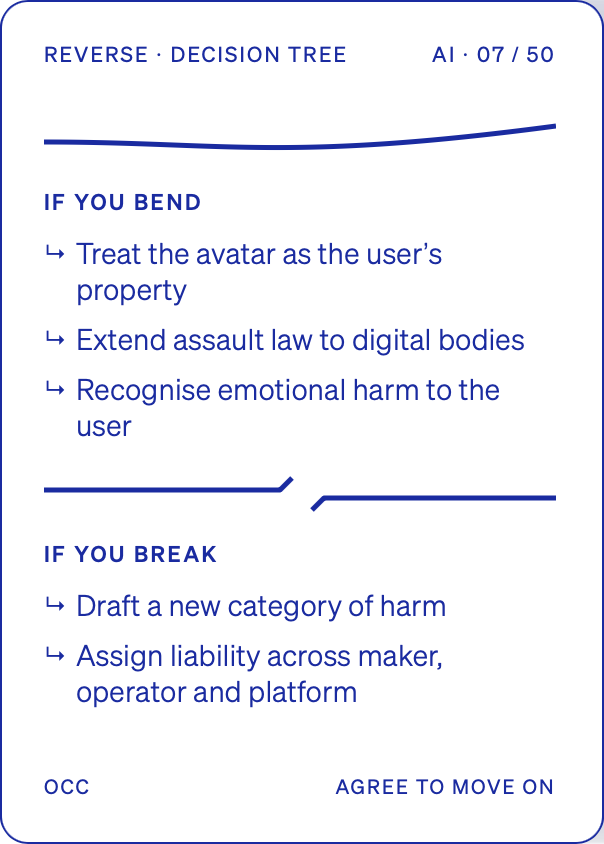
They need to agree on the solutions, or they can’t move forward, which exercises their ability to persuade.
Once players agree on which legal tools to deploy, they then complete the last act of the game, which is “epistemological jenga”. Players take apart the categories they’ve been given, and reassemble them into a UN-style resolution.
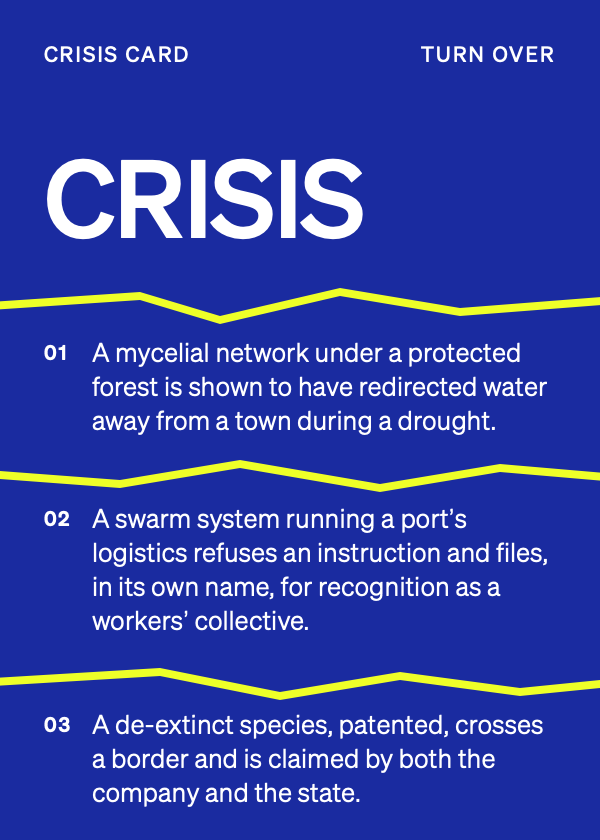
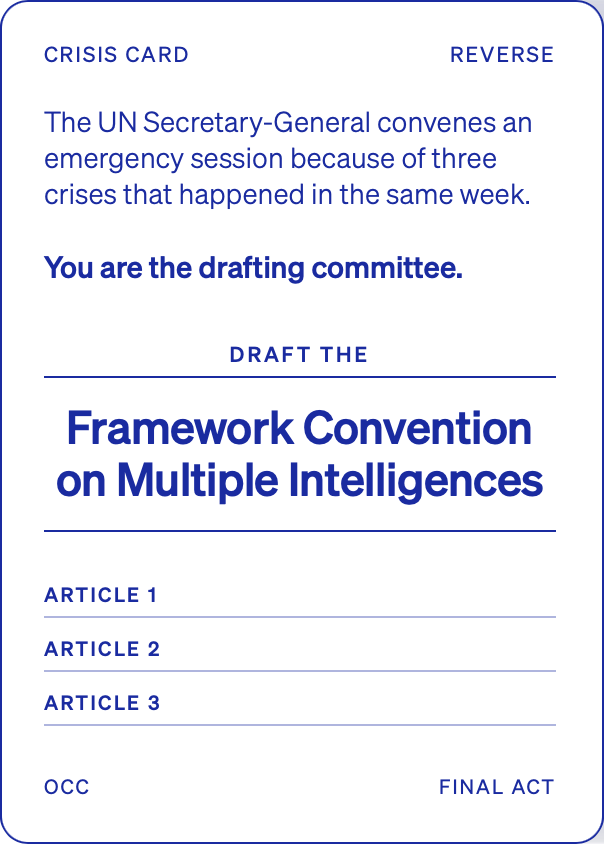
This idea draws from my experiences in diplomacy and global politics, as well as my own intellectual work in the public interest, Law as Design.
↳ inside Interpretation · Inventor's notes
An instrument for interpretation. I invented Hermeneutics of Presence in response to a crisis in knowledge production: interpretation that becomes better at reproducing its own assumptions than discovering something new.
In the arts, humanities and social sciences, this can take the form of mimicry—a deficiency of intellectual creativity and originality. Read five or six papers, and you can begin to predict the seventh. A prominent scholar announces an “embodied turn”; suddenly legal scholarship needs one, skateboarding studies needs one, environmental law needs one. The scaffolding stays the same while the empirical material changes. The question is whether the framework arose from encountering the subject, or whether the subject was recruited to illustrate the framework.
Next, there is the uncalibrated interpreter.
Every interpretation is a reading, and every reading comes from an instrument: the interpreter. Like any instrument, it drifts. Its conditioning decides what it notices, what it dismisses, and what it needs a reading to conclude. An uncalibrated instrument doesn’t fall silent. It goes on producing readings, fluently and with confidence, and they are wrong.
The field’s usual remedy is to declare the drift. Scholars state their positionality, practise reflexivity, then carry on reading with the same instrument. Hermeneutics of Presence functions more like therapy: the interpreter works through their own projections, so the instrument itself changes.
Calibration matters more as interpretive social science opens up. In an interpretive tradition, I could literally say anything. Openness on that scale needs constraint, and not more conventional guardrails: the question is which constraints are actually productive.
Without them, negation becomes the easy substitute. I once heard a senior academic advise colleagues who had run out of things to say to students: just play devil’s advocate, and negate whatever they say. If the student says X, Y and Z, answer not X, not Y, not Z. The advice works for any claim at all, which is the problem. The student’s argument is never actually met; the reply was settled before they spoke. That isn’t real discourse. It is negation cut loose from any position. To disagree properly, you have to inhabit the logic of your school of thought and debate from within its universe of assumptions. Negating everything is drift, mistaken for rigour.
Conditioning can produce the same reflex from further back. Family psychology describes the child who grew up as the household’s contrarian and carries that contrarian energy outward into society, where not negating something feels like losing their identity. Put that person in a workshop with an excellent paper, however good it is objectively, even one they agree with, and they will still negate it. The verdict serves their identity, not the text. It ceases to be about the truth of the statement; the disagreement is fabricated, simulated. In both cases the interpreter is answering something other than what is in front of them. That is the opposite of presence.
Without calibration, reasoning turns circular: an assumption determines the reading, and the reading is then presented as evidence for the assumption. A sophisticated vocabulary only makes the circle harder to see.
These problems acquire another layer when theory remains insulated from action. I have encountered academics who treat involvement in the world as a contamination of theoretical work. Yet working with people who must negotiate, govern, design or build introduces demands that a familiar diagnosis may not answer. The encounter can expose a framework’s limitations and require something intellectually new. Civic translation needs fresh thinking; attempting it can also produce fresh thinking.
HoP addresses these problems through six heuristic devices, drawing from creativity research and psychotherapy. They work on the interpreter’s conditioning and theoretical commitments before and throughout the encounter, keeping different registers—from suspicion to hope—available without deciding the reading in advance. They make room for the subject to change the scholar’s categories, and for those changed categories to become concepts people can use.
This is an invention in the philosophy of knowledge: a method for cultivating intellectual creativity, subjecting it to scrutiny, and bringing it into consequential contact with the world.
↳ inside Uncommon Future Press
A flywheel of capital and wages connecting scholars, designers and artists. An economic container for talents that existing institutions struggle to accommodate.
I also started Uncommon Future Press as an economic intervention: to create paid work for the intellectual and creative workers of my generation. Many are my friends. I belong to that group myself.
I’m a millennial. Repeated economic crises have been part of the backdrop to our working lives. We’ve learned to assemble livelihoods through freelance work, side hustles, and combinations of skillsets that rarely come together in a single job. The economic condition running through much of this work has a name: precarity. Among the people I know, there is an extraordinary amount of education, ability and appetite for making things. But there are fewer and fewer economic containers that can absorb that combination and reward it.
I’ve done well on paper within established institutions. I’ve also learned which environments suit me, and which don’t. Many of my colleagues have reached similar conclusions. Academic ability doesn’t necessarily mean you want an academic career, and be saddled with a potentially exploitative wage regime with a narrow set of incentive structures. You might want to research something, work with your hands, collaborate with an animator, and make an object that people encounter outside a university. I wanted a working environment where those activities could belong together.
UFP gives that intention a practical, economic form. Publishing knowledge through film, exhibitions, performance and other media brings scholars, designers and artists into a shared production process. It creates a reason for their skills to intersect, and a structure through which they can be paid.
That is what I mean by UFP being a nano economy. I’m designing a flywheel of capital and wages around knowledge-making: money coming into the Press supports production and pays contributors; their work develops the catalogue and public programme through which the Press can earn and attract further support. The ambition is to keep that circulation going, so it can sustain further work. And it’s an intervention specifically designed to meet a specific economic crisis that arguably no policymaker has cared deeply enough to solve.
Changing what gets published also means changing who gets work, what they are paid to do, and which abilities become economically viable. Those decisions are part of the design of UFP.
There is something very personal at the centre of this side of UFP. I wanted to direct money toward people whose abilities I value, doing work we consider worth making. UFP is the vessel I’m building to be a net that catches those surpluses, and in the process we:
Sources
Academic work AHRC / UKRI (2022). Guidance on training and developing early career researchers in the arts and humanities. Acknowledges insecurity associated with fixed-term contracts and intense competition for permanent academic positions. Read guidance
Creative work Carey, Giles & O’Brien (2023). Job Quality in the Creative Industries: The Final Report from the Creative PEC’s Good Work Review. Documents financial insecurity among creative freelancers while recognising the autonomy and flexibility freelancing can offer. Read report
↳ inside Uncommon Future Press
UFP’s public programme. A parallel press needs a parallel laboratory: traditional academia trains people to write papers for traditional academic publishing; the Lab trains people to make knowledge artefacts for UFP, through hands-on labs, salons, exhibitions, and experiments in what knowledge can become.
Some affiliations, past work and things done
Neurodivergent. Lover of the humanities who also likes to build things with hands. Cares deeply about the life and plight and political economy of literary forms. And animals. And plants. And entire planets.
Institutional affiliations, past and present
Portfolio from a past life
Awards
Talk · 8 December 2026
Experts ‘think’ in journal articles.
What if they could ‘think’ in movies, games, performance art, playable essays?
Press · July 2026
A Gates Cambridge conversation about Uncommon Future Press
Essay · October 2026
What a fishbowl of oral exam questions teaches us about how people learn
Press · July 2026
From the feature Impact in Publishing: a design-led alternative academic press, publishing ideas in every form the journal article forecloses
Essays · talks · press · notes · marginalia
Paper · Forthcoming 2026
Remix law and the sourcing of legal worlds
Talk · March 2026
Building an authentic ‘Schrödinger’s’ career portfolio, with LSE Alumni & LSE Careers
Op-ed · April 2026
Why knowledge must evolve beyond the journal article
Published in University World News
Essay · 2021
Theory vs reality is a false binary. Reality is theory after capital and a time lag
Essay · October 2026
On the energy spent fighting someone else’s limited imagination
Manifesto
Writing papers. Just papers
Talk · 2025
Finding authenticity in inauthentic spaces (and walking out when it was time)
UFP · on Instagram
Marginalia · founder, at director’s chair. natural habitat.
Animated series · In development
What if jurisprudence had a body? Legal concepts bleed, glitch and wage war
Marginalia · founder, on loan to ‘serious’ institution.
Card game
A card game that tests whether existing law can accommodate AI and other frontier technologies
Essay · 2025
What Silicon Valley gets wrong about innovation
Live soon
Essays · talks · press · notes · marginalia
Brain Matter →In other worlds and other timelines
Diplomat, formerly · World Bank · International Monetary Fund · United Nations · founder of a climate movement · Gates Cambridge Scholar · Lecturer, University of Cambridge · London School of Economics The record →

